
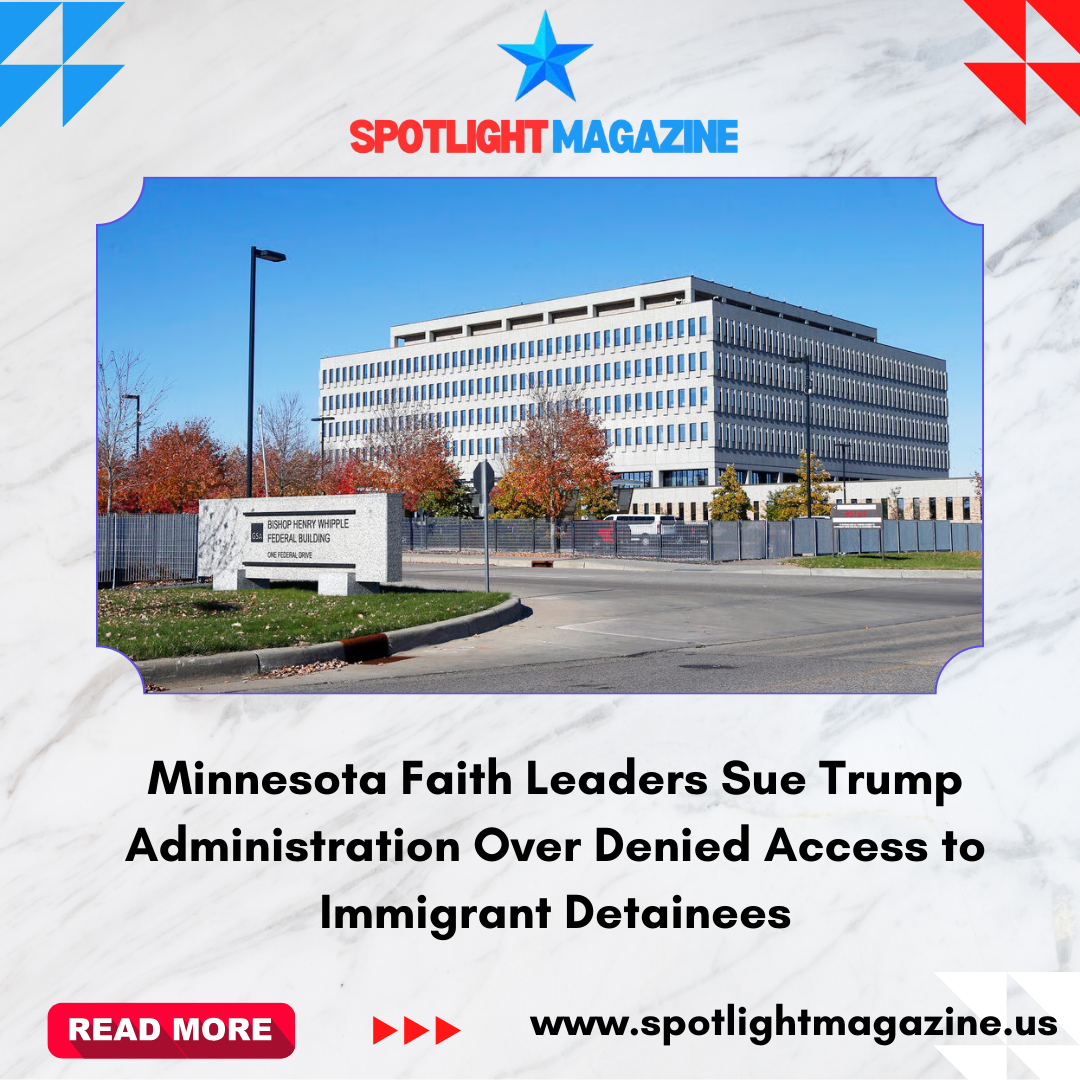
Religious leaders in Minnesota have taken legal action against the Trump administration, claiming they were unfairly blocked from offering spiritual support to people being held by federal immigration officials. The clergy — including groups from several churches and a Jesuit priest — filed a federal lawsuit saying that officials prevented them from entering the Bishop Henry Whipple Federal Building in Minneapolis to provide pastoral care to immigrants detained there. They argue this denial violates their religious freedoms and harms people in detention.
The lawsuit was filed in federal court and lists the Department of Homeland Security, Homeland Security Secretary Kristi Noem, and U.S. Immigration and Customs Enforcement Acting Director Todd Lyons as defendants. In it, the clergy say that people being held by immigration authorities often lack access to spiritual and legal support, and that providing pastoral care is a key part of treating them with dignity and humanity. They say that what happened at the Whipple building interferes with religious practice and breaks the Constitution’s guarantee of freedom of religion as well as federal religious rights laws.
According to the complaint, faith leaders were repeatedly turned away from the Whipple building when they tried to enter and minister to detainees. They say officials would not allow them even to reach the building’s parking lot, often telling them they could not enter because of vague “safety and security” reasons. This has continued since Operation Metro Surge began in December — a large increase in federal immigration enforcement activity in Minnesota.
The clergy also point to specific incidents where access was denied. One occurred on Ash Wednesday, an important holy day in the Christian calendar, when clergy wanted to administer the ash ritual to Christian detainees. While courts in other states have ordered immigration authorities to allow clergy to give Communion to detainees at certain facilities, the Minnesota clergy say they were turned away instead and not given a reasonable way to follow safety protocols to be admitted.
Defendants in the lawsuit have said the Whipple building isn’t a traditional detention center. Instead, they describe it as a processing facility where people are only held for a short time before being moved elsewhere. They argue this means formal pastoral services aren’t typically offered there, and they have invited religious groups to provide services at standard immigration detention centers. But the clergy say that even brief detention can be a time of deep fear and confusion for people separated from their families or facing deportation, and that they should not be denied spiritual support just because of facility labels.
Beyond the denial at the Whipple building, the lawsuit also mentions other actions by federal authorities that the clergy view as hostile to religious life and community involvement. These include reports of immigration enforcement vehicles circling churches during services, pastors being sprayed with pepper spray while protesting immigration actions, and at least one church canceling a Sunday service because its congregation was afraid of immigration enforcement activity nearby.
Many churches in Minnesota have formed strong networks to support immigrants in recent months. Some have organized food distribution for immigrant families afraid to leave their homes, participated in protests, and pushed political leaders to reconsider immigration policies. The lawsuit makes clear that the clergy are not challenging enforcement of immigration laws themselves, but are focused on what they see as a basic, non-political duty: being able to provide spiritual care to people in vulnerable situations regardless of their legal status.
Even though the federal government said in February that it was ending Operation Metro Surge, the clergy say nothing has changed in terms of their ability to visit detainees at Whipple. They are asking the court to order the government to stop blocking their access, to let them visit detainees in person, and to establish a clear and fair process by which clergy can schedule pastoral visits in the future.