
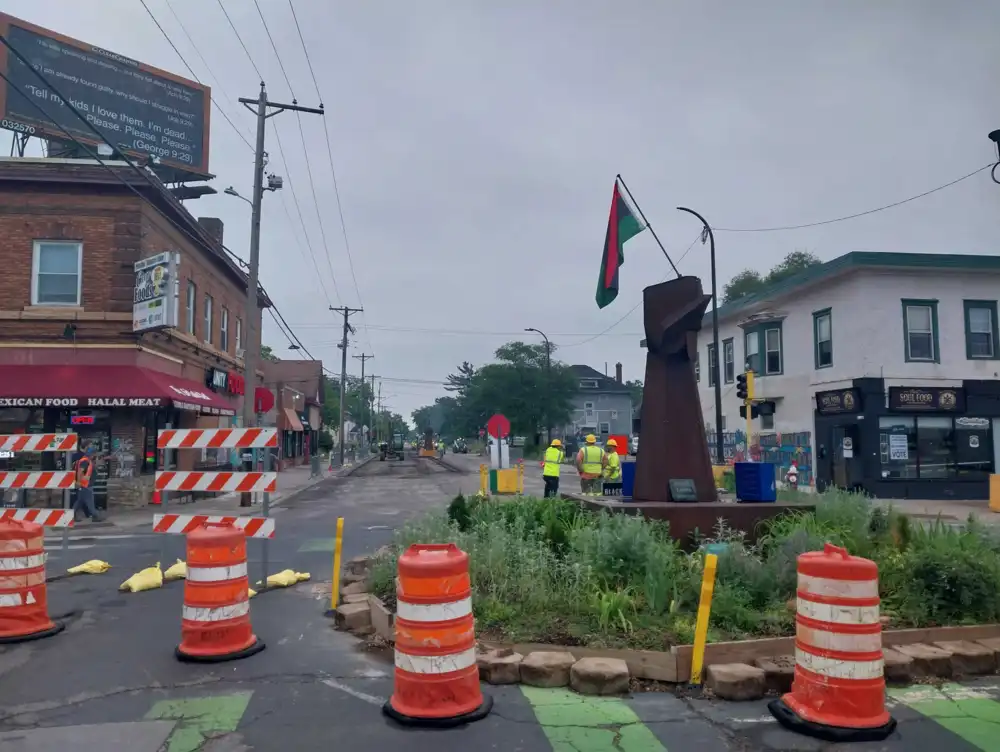
The Minneapolis City Council has voted to block a high-profile redevelopment contract at 38th Street and Chicago Avenue while simultaneously waiving an impending infrastructure tax on neighboring properties. In a resounding 10-2 vote on Thursday, lawmakers officially denied exclusive development rights to the Minnesota Agape Movement, effectively putting the future of the vacant gas station known as “The Peoples’ Way” back at square one. While municipal planning staff had formally recommended Agape for the two-year pre-development period based on their robust local presence, the plan faced steep resistance from lawmakers and activist groups who argued that the selection completely disregarded the clear wishes of the local neighborhood.
The sudden legislative rejection centered heavily on conflicting community survey data collected by the city. The municipal evaluation of roughly 800 participants showed that 58 percent of neighborhood respondents favored Rise and Remember—a preservation organization led by the square’s long-term memorial caretakers—while only 36 percent agreed with Agape’s multi-story commercial concept. Ward 9 Councilmember Jason Chavez and other critics publicly lambasted the mayoral administration for allegedly withholding the survey results for a year before bypassing the public’s preference. Furthermore, council opponents raised logistical concerns over Agape’s total lack of real estate experience, questioning the group’s capacity to lead a massive development despite their highly respected street-level violence interruption work.
In a rare display of legislative unanimity, the Minneapolis City Council shifted course to address another mounting point of neighborhood contention by completely eliminating a $630,000 special tax assessment. The standard municipal fee had been levied on adjacent property owners to help absorb the costs of a multi-million-dollar street reconstruction project that officially broke ground at the intersection. Business owners and area residents fiercely protested the financial burden, pointing out that their enterprises were already reeling from years of sustained economic hardship and that it was fundamentally unjust to charge the community for an infrastructure redesign resulting from a state-inflicted tragedy.
Council Member Soren Stevenson, who spearheaded the unified push to rescind the fees, asserted that the city could not bill the community for a project promoted as a public service. While some council representatives cautioned that the property tax waiver constitutes an extraordinary, one-time solution that must not set a permanent legislative precedent for standard municipal upgrades, local entrepreneurs expressed immense relief. As the broader George Floyd Square development and road construction continues its multi-year timeline, city leaders, municipal planners, and activist networks are now left looking to establish a more collaborative procurement framework to ensure future projects smoothly align with local intent.