
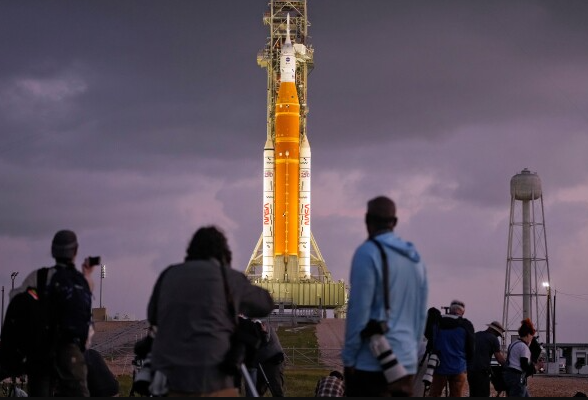
NASA is shooting for the moon Artemis II mission, marking a major step forward in humanity’s return to deep space exploration. As the first crewed mission in the Artemis programme, Artemis II is designed to carry astronauts around the Moon and back, setting the stage for future lunar landings.
The mission represents a critical milestone for NASA’s long-term goal of establishing a sustainable human presence on the Moon. Unlike its predecessor, Artemis I, which flew uncrewed in 2022 to test systems, Artemis II will place astronauts aboard the Orion spacecraft for a journey that will push the boundaries of modern human spaceflight. The mission will not land on the Moon but will perform a flyby, testing life-support systems, navigation, and crew operations in deep space.
At the centre of the mission is the Orion spacecraft, built to carry humans farther than any previous NASA vehicle designed for long-duration missions. Orion will be launched atop the Space Launch System rocket, the most powerful rocket developed by NASA to date. Together, these technologies form the backbone of the Artemis programme, which aims to return humans to the lunar surface later this decade.
The Artemis II mission details reveal a carefully planned trajectory that will take the crew thousands of miles beyond the Moon before looping back to Earth. This extended path is intended to simulate conditions for future missions, including Artemis III, which aims to land astronauts on the lunar surface. Engineers and scientists are closely monitoring every aspect of the mission to ensure safety and reliability.
NASA officials have emphasised that Artemis II is not just a technical test but a symbolic moment in space exploration. It will be the first time humans travel beyond low Earth orbit since the Apollo era, reconnecting with a legacy that last saw astronauts orbit the Moon in 1972. The mission also reflects a new era of international and commercial collaboration, with partners contributing to various aspects of the broader Artemis programme.
Beyond its technical achievements, the NASA lunar mission carries broader significance for science and exploration. Data collected during the flight will inform future missions, including potential journeys to Mars. The experience gained in deep space will help refine strategies for long-duration human travel, a key objective for space agencies worldwide.
As NASA is shooting for the moon Artemis II mission, global attention is once again turning skyward. For many, the mission represents both a return to the past and a leap into the future, bridging decades of exploration with new ambitions. With astronauts preparing for this historic journey, Artemis II stands as a defining chapter in the ongoing story of human spaceflight.