
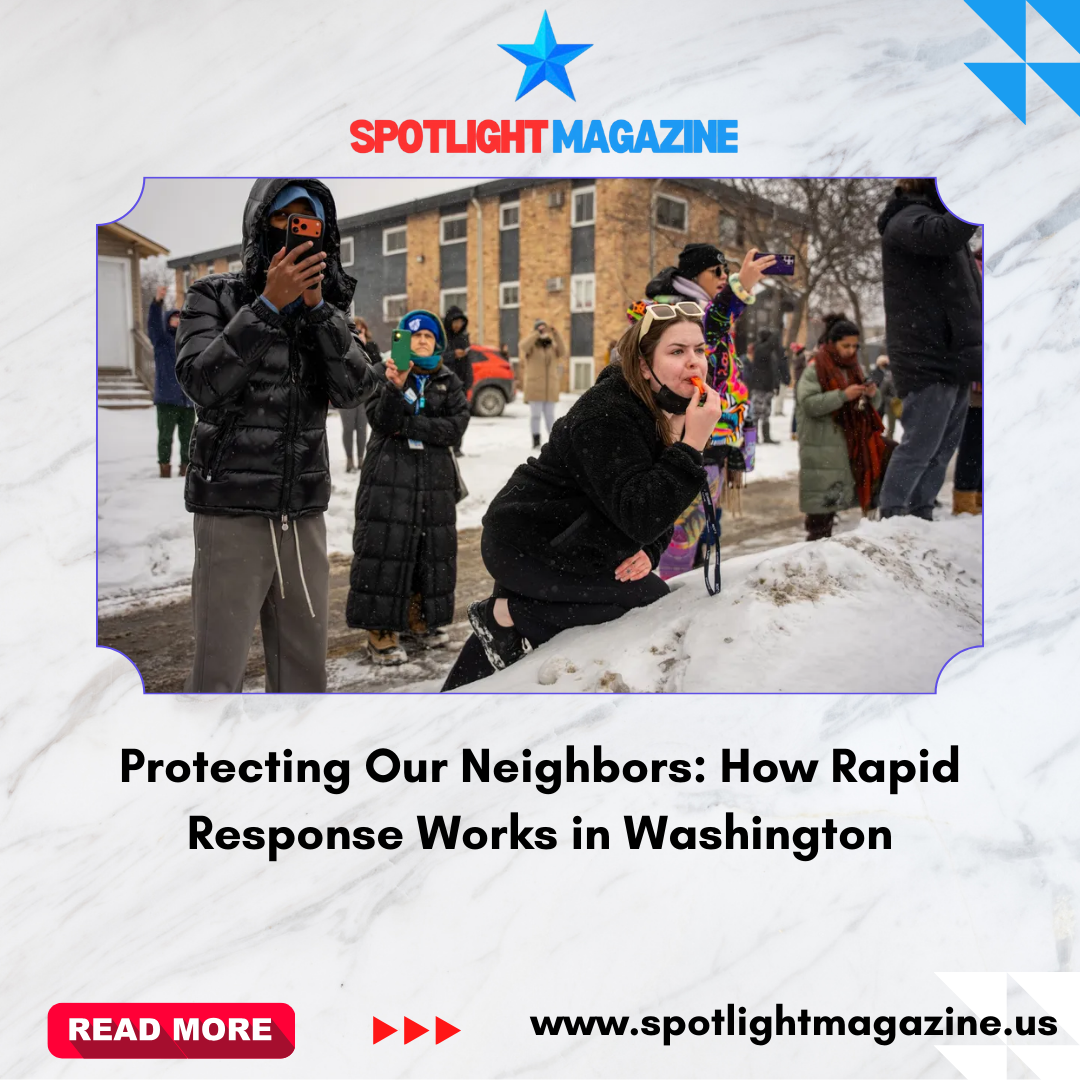
In Washington state, a growing movement of community members is organizing to protect their neighbors from federal immigration enforcement. Central to this effort is the “Rapid Response” network, primarily managed by the Washington Immigrant Solidarity Network (WAISN). This system is designed to provide immediate support and documentation when U.S. Immigration and Customs Enforcement (ICE) or Border Patrol agents are active in local neighborhoods.
Rapid response is a community-led strategy that relies on volunteers to act as legal observers. These volunteers are trained to remain calm and focused during high-stress situations. Their primary goal is not to interfere with law enforcement or engage in confrontation, but rather to document exactly what is happening. This documentation provides a factual record that can be crucial for legal defense and for ensuring that the rights of detained individuals are respected.
When someone witnesses ICE activity, they are encouraged to call a dedicated deportation defense hotline. This call triggers a notification system, often through secure, encrypted messaging apps like Signal, to alert nearby volunteers. Once on the scene, responders perform specific roles: some record video to capture the overall scene, others focus on specific details like agent identification or vehicle license plates, and some attempt to speak with the person being detained to gather vital information for their family and legal counsel.
A unique and increasingly popular tool within this movement is the use of whistles. Organizations like “WA Whistles” distribute 3D-printed or referee-style whistles to community members. The idea is simple: if you see immigration enforcement activity, you blow the whistle to alert your neighbors. This serves multiple purposes. First, it warns people who may be at risk so they can avoid the area. Second, it calls on the community to gather—not for violence, but to provide a “fistful of loud” visibility. The sound turns a quiet, sudden abduction into a public event, making it harder for agents to act without oversight.
The legality of these actions is a common question. In the United States, you have a constitutionally protected right to film law enforcement officers performing their duties in public spaces. As long as you are not physically obstructing an officer’s work, recording the scene is legal and encouraged by advocacy groups. Similarly, blowing a whistle to alert others is generally viewed as a form of protected speech and community signaling.
Beyond the immediate scene, the Rapid Response network provides essential follow-up care. Because ICE often moves very quickly—sometimes finishing an operation in under three minutes—volunteers may arrive after a person has already been taken. In these cases, the focus shifts to family support. Responders help connect families with legal services, provide information on where their loved ones might be held, and offer resources for those who may have lost their household’s primary breadwinner.
This grassroots effort reflects a broader commitment in Washington to being a welcoming and safe place for all residents, regardless of their immigration status. By combining modern technology like encrypted apps with simple tools like whistles, residents are building a safety net rooted in solidarity. The ultimate goal is to ensure that no one in the community has to face the threat of deportation alone or in silence.