
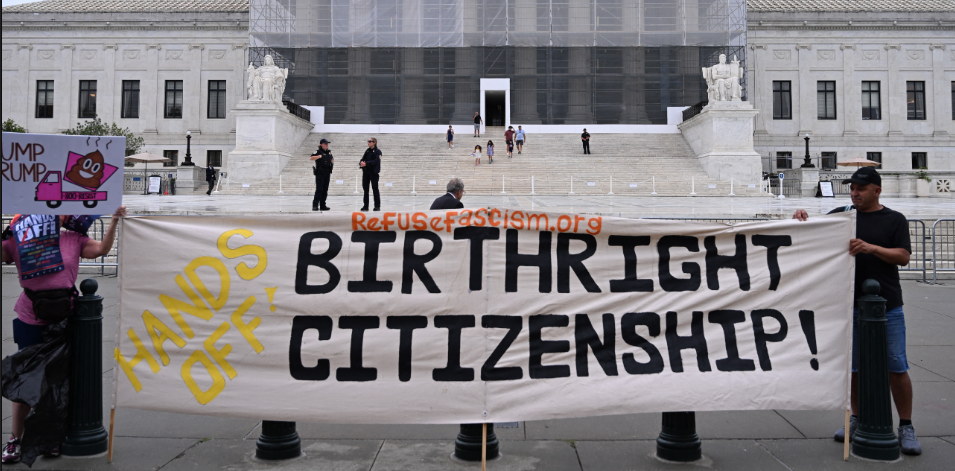
The Supreme Court considers historic case on birthright citizenship in a legal battle that could redefine one of the most fundamental principles of national identity: who is recognised as a citizen at birth. The case, now drawing national and international attention, centres on the interpretation of longstanding constitutional protections and their application in modern immigration policy.
At the heart of the dispute is the 14th Amendment, which has for more than a century guaranteed citizenship to nearly all individuals born on U.S. soil. Legal scholars widely interpret its citizenship clause as establishing birthright citizenship, regardless of parental immigration status. However, the current case challenges aspects of that understanding, raising questions about the limits and conditions under which citizenship is granted.
The Supreme Court’s review comes amid a broader birthright citizenship debate that has gained traction in political and legal circles in recent years. Proponents of revisiting the interpretation argue that evolving immigration dynamics require a more narrowly defined application of the law. Opponents, including many constitutional experts, warn that altering this principle could undermine established constitutional rights and create uncertainty for millions.
During proceedings, justices examined historical precedents, including landmark rulings that have upheld the broad interpretation of the 14th Amendment citizenship clause. Legal arguments presented to the court have focused on whether the original intent of the amendment aligns with contemporary applications, particularly in cases involving children born to non-citizen parents.
The implications of the case extend beyond legal theory. A shift in how birthright citizenship is defined could significantly impact immigration policy in the United States, potentially affecting families, communities, and future generations. Advocacy groups on both sides have mobilised, highlighting the human and societal dimensions of what might otherwise appear to be a purely constitutional question.
Observers note that the case also reflects deeper political and cultural divisions surrounding immigration and national identity. While the court maintains its role as an independent arbiter, its decision is expected to influence policy debates and legislative agendas in the years ahead.
Internationally, the case is being closely watched, particularly in regions where questions of citizenship and identity remain sensitive. For many, the outcome may set a precedent or at least contribute to global discussions on citizenship laws and human rights.
As the Supreme Court considers historic case on birthright citizenship, a final ruling is anticipated to carry far-reaching consequences. Whether it reaffirms existing interpretations or introduces new legal boundaries, the decision will shape the future of citizenship in one of the world’s most influential democracies.