
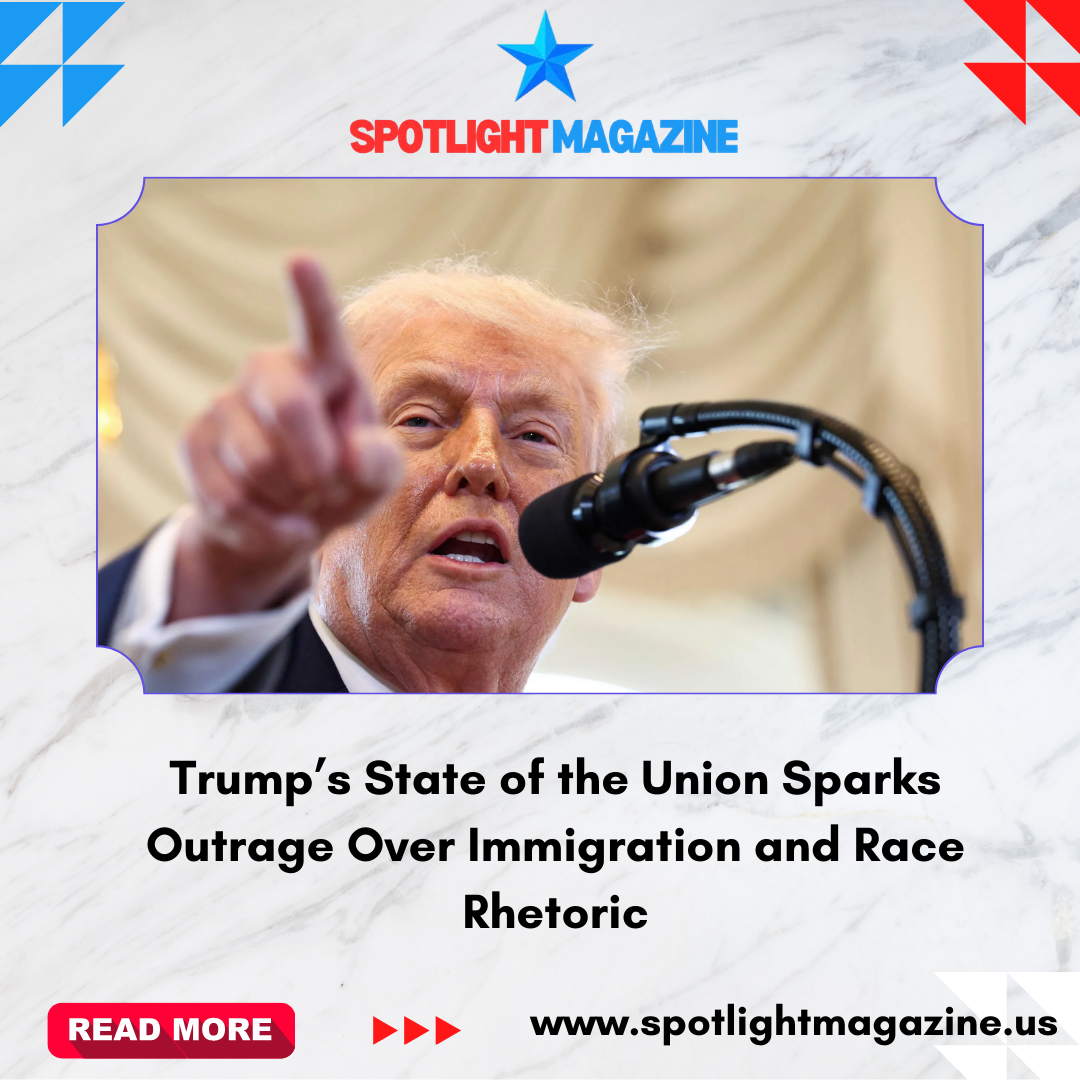
Former President Donald Trump gave what many are calling an unusually long and controversial State of the Union address to Congress, and critics outside and inside the U.S. see it as a significant moment in his presidency. The event, which lasted nearly two hours, drew sharp reactions because of the tone and content of Trump’s remarks and actions during and immediately after the speech.
Trump’s address focused heavily on immigration, crime, and what he described as threats to American safety and culture. However, in doing so he used language that many observers called inflammatory, offensive, and racially charged. Much of the criticism has centered on his repeated attacks on immigrants, especially Somali Americans, and the way he framed these comments. One commentator quoted in news summaries described parts of the speech as possibly “the most openly racist State of the Union in modern history.”
One specific example that drew attention was Trump’s reference to Somali Americans living in Minnesota. He spoke about “Somali pirates” and claimed that their communities led to lawlessness without providing clear evidence for these claims. This sort of language was seen by critics as unfairly targeting a specific ethnic and religious group and spreading harmful stereotypes.
The speech also sparked protests inside Congress. During the address, Representative Al Green, a Democratic lawmaker from Texas, stood up and displayed a sign saying “Black People Aren’t Apes.” This was in response to a racist video that had been shared on Trump’s Truth Social account earlier in the week, which depicted Barack and Michelle Obama in a derogatory way. Green said he felt he had to take a stand against what he saw as normalization of racist imagery. He was removed from the chamber by House security after displaying the sign, and his protest became a headline on its own.
Trump’s defenders argue that his speech was a forceful attempt to address issues he believes are important to his base, such as border security and economic concerns. He spoke at length about what he sees as failures in immigration policy, rising crime rates, and problems with U.S. elections. His supporters have praised the length and detail of the address, saying it showed he is willing to tackle difficult topics. They also dismiss accusations of racism as politically motivated criticisms from his opponents.
But independent fact–checkers and news organizations have pointed out that many of Trump’s claims about crime, elections, and immigration don’t align with available data. For instance, crime in the U.S. has seen declines in recent years, and widespread voter fraud has not been substantiated by reliable evidence. Critics also say that linking entire communities to crime or unrest without proof contributes to fear rather than understanding.
The aftermath of the State of the Union showed how divided the country remains over Trump’s leadership. Some political leaders and commentators said the speech crossed a line by using rhetoric that could deepen racial and cultural tensions. Others say that Trump was simply speaking bluntly about issues they agree need attention. The response from both sides highlights a broader struggle in American politics over how public officials talk about race, immigration, and national identity.
Some media outlets also noted that several Republican lawmakers had a muted reaction to the more controversial lines in Trump’s speech, suggesting that party unity may sometimes outweigh concern about harmful language. Meanwhile, groups that advocate for civil rights and immigrant communities spoke out strongly against the tone of the address.
In summary, Trump’s latest State of the Union address became more than just a statement of policy. It turned into a flashpoint for debates about racism, immigration, and political leadership in the U.S. Many observers are using it as a lens through which to understand how Trump’s second term is shaping up and how it might affect social cohesion and trust in government.