
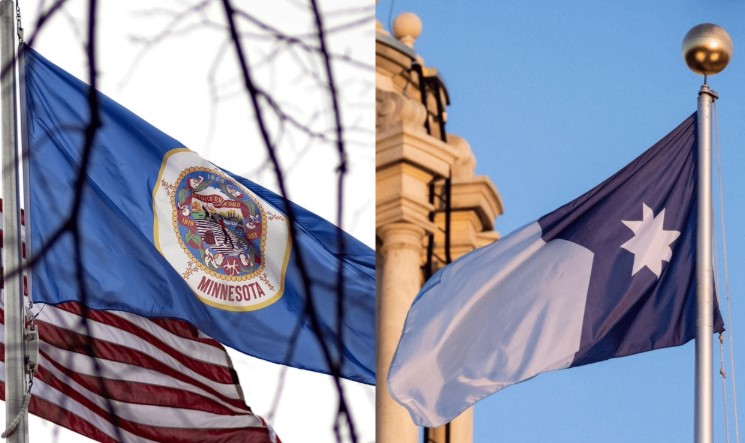
A growing Minnesota state flag movement has emerged in parts of the state, where some cities and local institutions are choosing not to fly the official flag design adopted in 2024. The trend has sparked debate about civic identity, local authority, and the role of state symbols in public spaces.
The current Minnesota flag was officially adopted following a redesign process led by a state commission, replacing the previous version that had been in use for decades. The new design was intended to modernize the symbol and address longstanding concerns about inclusivity and representation. However, it has also generated political and cultural disagreement in some communities.
According to reporting from Minnesota Public Radio News, several local governments have either voted to continue flying the older flag, display no state flag at all, or avoid adopting the new design entirely, even though it is the official state emblem. Observers note that these decisions are not necessarily illegal, as Minnesota law requires the official flag to be flown at the State Capitol but does not strictly mandate uniform adoption by all local governments.
At the State Capitol in St. Paul, however, the official flag is required to be displayed between sunrise and sunset, reinforcing its legal status as the state’s symbol. Beyond state buildings, decisions about flag display largely fall to city councils, county boards, and individual institutions, creating space for variation across Minnesota.
Supporters of the movement to reject or replace the official flag argue that local communities should have a say in which symbols represent them. Some critics of the redesign have also raised concerns about the process that led to its adoption, suggesting it did not adequately reflect public input. Early reports indicate that in a few communities, residents have formally petitioned local councils to revert to earlier flag designs.
On the other hand, supporters of the official flag argue that statewide symbols are meant to unify, not fragment, public identity. They also note that redesign efforts were part of a structured legislative process involving public commissions and design review, aiming to create a more modern and inclusive representation of Minnesota.
The debate has become part of a broader discussion about civic symbolism in the United States, where state flags often carry historical, cultural, and political meaning beyond their visual design. In Minnesota, that conversation has been amplified by contrasting opinions about tradition versus change, as well as differing interpretations of what the flag represents.
For now, the Minnesota state flag movement remains localized but visible, reflecting how even official state symbols can become points of political and cultural negotiation at the community level.