
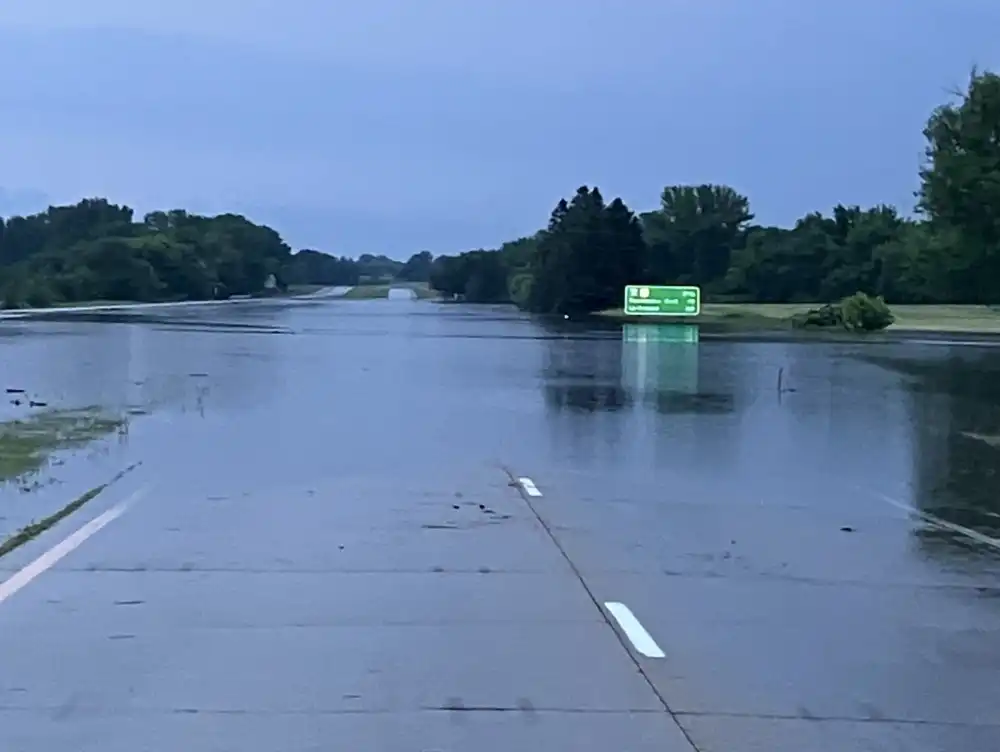
The alarming situation where flash flooding closes Interstate 90 in southern Minnesota underscores the increasing vulnerability of regional transport infrastructure to extreme summer weather anomalies. Following an intense, prolonged overnight deluge that dropped between five and seven inches of torrential rain across the region, state public safety officials were forced to shut down a major multi-mile corridor of the critical thoroughfare. According to reports issued by the Mower County Sheriff’s Office, the continuous rising waters completely submerged both the eastbound and westbound lanes near the town of Dexter, situated directly between Austin and Rochester. State engineers arriving at the scene documented substantial pooling of deep water across the traffic lanes alongside severe shoulder erosion, creating highly hazardous conditions that made normal vehicular travel entirely impossible.
The sudden closure has heavily disrupted local commerce and interstate travel along one of the most vital logistical arteries connecting the upper Midwest. The Minnesota Department of Transportation quickly implemented emergency detour routes, instructing drivers to navigate around the waterlogged zone via designated secondary state highways. Concurrently, the National Weather Service issued urgent flash flood warnings spanning multiple surrounding counties, including Mower, Fillmore, and Houston. Weather experts explicitly emphasized that even small amounts of rushing water can easily stall passenger vehicles or cause operators to lose absolute control, prompting a widespread public campaign urging motorists to avoid driving through standing water under any circumstances.
Local emergency management personnel have been working continuously to monitor deteriorating conditions as small creeks and nearby agricultural drainage systems overflow their banks. Early field assessments suggest that several rural communities adjacent to the closed interstate are dealing with flooded basements, isolated secondary roadways, and minor power grid failures. While public safety networks have not reported any immediate casualties or serious injuries related to the high waters, the swift accumulation of rainfall has put an immense strain on local municipal utility systems. State meteorologists indicate that these severe weather patterns are part of a broader, highly unstable atmospheric system moving directly across the region, which has also triggered severe thunderstorm watches, damaging straight-line winds, and localized hail threats.
As regional transport infrastructure teams wait for the floodwaters to naturally recede before conducting comprehensive structural safety inspections of the highway surface, the long-term impact on regional travel times remains uncertain. Commuters and freight operators are advised to utilize real-time digital transit maps to check for prolonged delays before attempting to cross the southern part of the state. Until the water is safely cleared and the integrity of the roadbed is fully verified by state engineers, the disruption where flash flooding closes Interstate 90 in southern Minnesota will continue to test the resilience of local emergency response frameworks.