
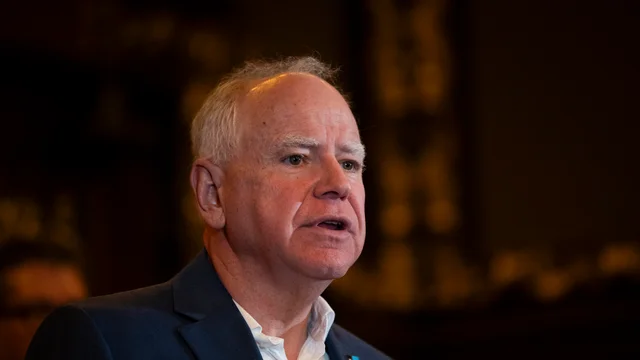
A bitter political showdown between state and federal leadership reached a breaking point as Governor Tim Walz announced a massive legal effort to uncover an alleged campaign of retribution targeting the state of Minnesota. In a decisive executive move on Tuesday, the governor’s legal team submitted sixteen separate Freedom of Information Act requests across multiple federal departments, demanding the immediate release of all internal memos, writings, and communications referencing the state. The aggressive data dragnet is specifically looking for federal documents containing keywords such as “Walz,” “reckoning,” “punish,” and “retribution” generated since early 2025. This escalating push for transparency marks a significant defensive escalation by the state’s executive branch, which claims federal agencies have weaponized administrative actions to penalize local governments over policy disagreements.
The sweeping records requests were formally dispatched to a wide network of powerful cabinet-level entities, including the Department of Justice, the Department of Homeland Security, and the Department of Transportation. State officials argue that Minnesota has been disproportionately subjected to over one hundred individual federal demands, funding threats, and targeted investigations over the past year. Walz explicitly stated that these coordinated federal interventions represent an unlawful attempt by the executive branch in Washington to squeeze state and local leaders who openly dissent from the president’s national agenda. While the administration in Washington has previously maintained that its aggressive investigative actions are purely rooted in standard oversight and regulatory compliance, state attorneys counter that the sheer volume of sudden audits indicates a highly organized, politically motivated pressure campaign.
The timing of the transparency offensive is directly linked to a major judicial victory secured by the state just twenty-four hours prior. On Monday, U.S. District Judge Patrick Schiltz quashed six federal grand jury subpoenas that had been issued against Walz, Attorney General Keith Ellison, and Minneapolis Mayor Jacob Frey. In a scathing ruling, Schiltz determined that the federal government’s legal maneuvers were entirely unconstitutional, finding that their dominant purpose was to harass local leaders and coerce them into assisting with aggressive federal immigration enforcement operations. The judicial rebuke centered on the controversial Operation Metro Surge, a massive winter federal immigration enforcement crackdown that triggered intense friction between federal agents and local municipal authorities.
Armed with the federal court’s validation, Minnesota officials are determined to expose the exact origin and financial toll of the federal government’s aggressive tactics. Legal analysts suggest that the resulting documents could lay the groundwork for further civil litigation if evidence proves that federal resources were intentionally diverted to punish political adversaries. As federal agencies prepare to process the massive information demands, the ongoing standoff underscores a profound constitutional crisis regarding state sovereignty and the boundaries of federal authority. For now, the successful quashing of the subpoenas has given state leaders a powerful legal foothold, transforming their defensive stance into an active investigation into the scope of the campaign of retribution targeting the state of Minnesota.